 By
By 


Family law guide
Part of: How to apply for Parental Responsibility
A declaration of parentage is a court order that says whether a named person is, or was, someone’s legal parent. Anyone can ask the family court or the High Court for one. However, unless you are the parent, the child or the child’s other parent in question, you must first show a sufficient personal interest in the answer (Family Law Act 1986, s.55A). This page covers England and Wales only, and our parental responsibility specialists assist and advise at each stage.
Reviewed by: Hannah Overton, Complex Children Specialist & Client Support, Kabir Family Law
Put simply, a declaration of parentage is the court’s final answer to one question: is this person the parent? It can confirm that someone is a parent. Equally, it can confirm that someone is not. The person whose parentage is in doubt may be a child or an adult, and the parent may have died.
Because the order binds everyone, it helps whenever a family or an official body needs certainty, for example about child maintenance or a birth record. After the order, a court officer sends a copy to the Registrar General within 21 days. If the birth should then be registered again, the Registrar General must allow it (Births and Deaths Registration Act 1953, s.14A).
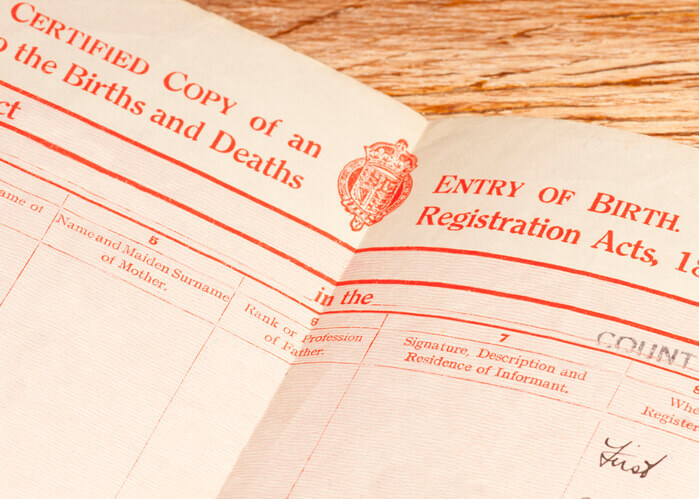
You may recognise one of these moments:
Sometimes a court order is not needed at all. For instance, if both parents agree, our guide on whether a father can put himself on the birth certificate explains the simpler route. If a man is wrongly named, see our guide to removing a name from a birth certificate.
Paternity law, UK-wide, is not one system. The declaration on this page comes from section 55A, which applies in England and Wales only. Here, the order answers one question: who the parent is. So it does not decide where a child lives, who they see, or who makes decisions for them.
In this kind of case, the court looks at all the evidence, which can include DNA test results. A judge can direct scientific tests without being asked, or when one of the people in the case asks. Only a body accredited for this work can carry out those tests. For more detail, read our guide to paternity testing for custody.
What if someone will not give a sample after the court directs a test? In that case, the court may draw whatever conclusions seem proper from that failure (Family Law Reform Act 1969, s.23). As a result, a refusal can count against the person who refuses. The judge then decides whether the evidence proves the point.
Before you start, gather what you can. This list helps you get organised, but it is not advice on your own facts.
A list gets you organised, but it cannot weigh your facts. For example, whether you have a sufficient personal interest, whether the case is in the child’s best interests, and how the order fits with contact are all judgement calls. So bring this list to a free initial consultation, where one of our specialists gives you initial advice on those points.
First, our specialists explain whether you can apply and whether this order is the right tool. Next, they talk you through the evidence the court will want, including how DNA testing works. They also help you prepare for each hearing. Finally, they explain how the order links to parental responsibility, contact and child maintenance.
A free initial consultation is a conversation with a specialist, who gives you initial advice tailored to your circumstances. It does not include drafting or reviewing documents. Have the names, dates and any test results to hand, so the time can focus on your questions.
The court fee to file the application is £426, according to the GOV.UK fees list. Help with Fees may cover some or all of it if your income and savings are low. DNA testing is not part of the court fee.
There is no fixed timescale. An agreed case with quick DNA results can move faster. By contrast, a disputed case with several hearings takes longer. Court workloads also vary, so ask a specialist for a realistic view of your own case.
No. The court can only make this kind of declaration on an application under the Family Law Act 1986, using form C63 (section 58(4)). However, the question of who a parent is can still come up inside other family cases, such as a child arrangements case. There, the court can decide the point for that case and direct DNA tests under section 20 of the Family Law Reform Act 1969.
Parentage simply means who a person’s legal parents are. For example, a man who is not on a child’s birth certificate may ask the court to confirm he is the father after a DNA test. Another example is an adult who asks the court to confirm that a man who has died was their father.
It can. After the order, the court tells the Registrar General. If it then appears that the birth should be registered again, the Registrar General must allow that, under section 14A of the Births and Deaths Registration Act 1953. The new entry then follows the court’s answer.
Advice before you file tells you whether the court is likely to hear your case, before you pay the £426 fee. Book a free initial consultation, where one of our specialists gives you initial advice tailored to your circumstances, or call 0330 094 5880. You can also return to our guide on how to apply for parental responsibility.
General information about the law in England and Wales, not advice on your circumstances.
We are often asked whether a home DNA kit is enough to settle things. It may not be, because when the court directs a test, only an accredited body can carry it out. So before you apply, keep a note of what everyone has said about testing. Then, if the court directs a test and someone fails to take part, the judge can draw proper conclusions from that.
Garry Steedman, Family Law Consultant (Divorce, Children & TOLATA)
8 of 41 guides — scroll sideways for more
 Section 37 Report
 Section 47 Report Explained: What Happens During Section 47 Enquiries?
 Placement Orders
 Parental Alienation & Alienating Behaviours
 Narcissistic Parental Alienation
 Practice Direction 12J: Your Complete Guide to Domestic Abuse Protection in Family Court
 Clare’s Law & Domestic Violence Disclosure Scheme
 Temporary Child Custody
Short videos from the Kabir Family Law team, explaining family law in plain English.
We are a team of legally trained family law and divorce specialists with years of experience across all areas of family law. We are not part of a firm of solicitors, do not undertake legal reserved activities unless permitted and are therefore entirely independent. Please subscribe to our mailing list.





Type a topic to see the pages that cover it, or choose one below.
Or choose a topic
Or call us on 0330 094 5880
A few things we have shared lately. Plain answers, quiet updates, and the occasional reminder that you are not the first person to stand where you are standing.
 Kabir Family Law, the start of the bright side of life.
View this Facebook post, opens in a new tab
Kabir Family Law, the start of the bright side of life.
View this Facebook post, opens in a new tab
 When the roots are deep there is no reason to fear the wind.
View this Instagram post, opens in a new tab
When the roots are deep there is no reason to fear the wind.
View this Instagram post, opens in a new tab
 Kabir Family Law brings hope to families in times of crisis.
View this X post, opens in a new tab
Kabir Family Law brings hope to families in times of crisis.
View this X post, opens in a new tab
 You are never truly alone. Sometimes the bravest thing you can do is ask…
View this Facebook post, opens in a new tab
You are never truly alone. Sometimes the bravest thing you can do is ask…
View this Facebook post, opens in a new tab
Would you rather talk it through with someone?
Book a free consultationThe first conversation with one of our family law specialists costs nothing.
12 Cathedral Rd
Pontcanna
Cardiff
CF11 9LJ
Friars House,
Coventry
CV1 2TE
Chester House
1st and 3rd Floors
81 - 83 Fulham High Street
Fulham
London
SW63JA
16 High Holborn
Holborn
London
WC1V6BX
Clavering House
Clavering Place
Newcastle upon Tyne
Tyne and Wear
NE1 3NG
20-30a Abington Street
Northampton
NN1 2JA
2 King St
Nottingham
NG1 2AS
1 & 3 Kings Meadow
Oxford
OX2 0DP
2 Copenhagen St
Worcester
WR1 2HB
Tower Court
3 Oakdale Road
North Yorkshire
York
YO30 4XL
You do not need the right words. Tell us what is happening, or pick whatever comes closest.
What is happening?