Family law guide
 By Tom Atkinson
Is parental responsibility automatic for a father who was not married to the mother?
Parental responsibility for an unmarried father, one who was not married to the child’s mother, is not automatic. He has to acquire it, by one of the three routes in Children Act 1989 s.4(1). This page explains what parental responsibility actually is, along with the three routes and their limits. It also sets out what the court weighs when a father applies for an order under s.4(1)(c). And it covers what parental responsibility does not give anyone.
Our guide to How to apply for Parental Responsibility sets out the wider legal picture.
How can an unmarried father get parental responsibility?
Section 4(1) of the Children Act 1989 gives an unmarried father three routes. He acquires parental responsibility by becoming registered as the child’s father under one of the enactments listed in section 4(1A), by making a parental responsibility agreement with the child’s mother, or by applying to the court for a parental responsibility order. The registration route is not retrospective: a father registered in England and Wales before 1 December 2003, when that route came into force, does not acquire parental responsibility from that register entry alone.
If you have just found out you have no parental responsibility
It usually comes out at the worst moment. The school will not release a report. The GP surgery will not discuss an appointment. Someone says, almost in passing, that you have no legal say over your own child. Then you realise nobody ever told you that parental responsibility for an unmarried father is not automatic. Being the father was never enough on its own. Perhaps your name is not on the birth certificate, or the birth was registered before December 2003. If so, that may well be where you stand tonight.
What you have read above is general information about the law in England and Wales. It is not advice about your child. In your own case, parental responsibility for an unmarried father turns on details a web page cannot know. When and where did the birth registration happen, and what does the mother agree to now? Did anyone sign anything years ago, and is contact already happening? Change one of those and the sensible next step changes with it. If you want to read further, you can find the Children Act 1989 in full at legislation.gov.uk.
A free initial consultation is a conversation, nothing more. You explain what has happened, in your own words and in confidence. A family law specialist asks you some questions. Then that specialist tells you plainly which routes to parental responsibility for an unmarried father are open to you. You also learn what each one would involve, and what would realistically happen next. There is no obligation to go any further, and nobody will push you. Most people come off that call knowing what they are actually dealing with. That is usually the thing they were missing.
To arrange a free initial consultation with a family law specialist, call 0330 094 5880.
The legal issue
Children Act 1989 s.2(2) draws the line. Where a child's father and mother were not married to, or civil partners of, each other at the time of the child's birth, the mother has parental responsibility, and the father has it only if he has acquired it, and has not ceased to have it, in accordance with the provisions of the Act.
Children Act 1989 s.4(1) sets out the three ways a father in that position acquires parental responsibility: (a) he becomes registered as the child's father under one of the enactments specified in s.4(1A); (b) he and the child's mother make a parental responsibility agreement; or (c) the court, on his application, orders that he shall have parental responsibility for the child.
Where the mother does not agree to an agreement under (b), and the registration route in (a) is not available, the remaining route is an application to the court under s.4(1)(c). The issue is then what parental responsibility is for, whether an order should be made, and what an order would and would not achieve.
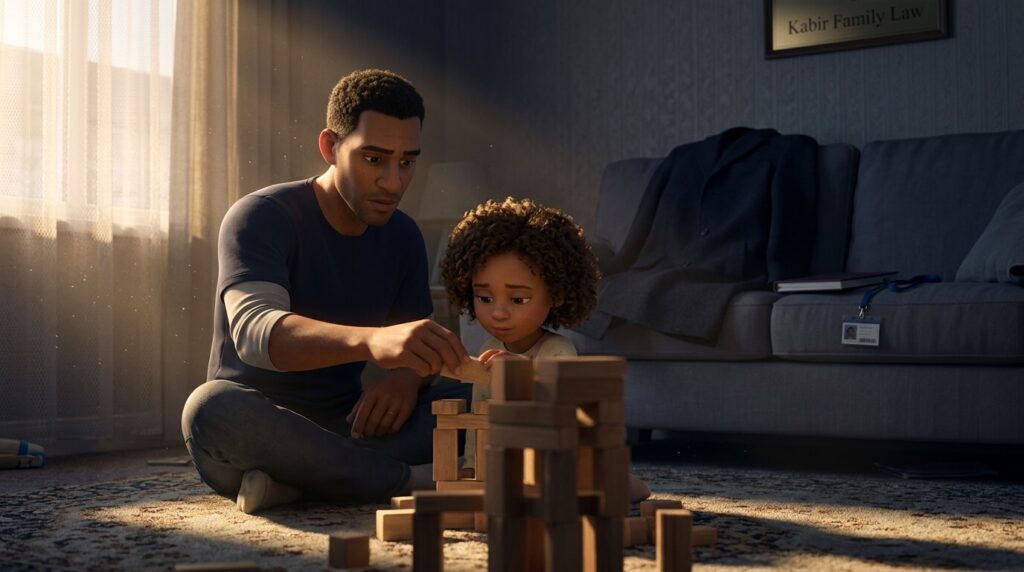
In this matter, the father did not already have parental responsibility because the parents were not married or civil partners when the child was born, and the birth-registration route had not given him parental responsibility. He had remained involved in the child’s life and wished to take a responsible role in important decisions affecting the child. The absence of parental responsibility created practical difficulties when information or consent was required in relation to the child’s welfare and day-to-day arrangements. The mother did not agree to a parental responsibility agreement, so the court route had to be considered.
The law this rests on
- Children Act 1989 s.1(1) (welfare the paramount consideration), s.1(3) (welfare checklist), s.1(4) (when the checklist applies), s.1(5) (the no-order principle)
- Children Act 1989 s.2(2) (unmarried parents), s.2(5), s.2(6), s.2(7), s.2(9) (how parental responsibility is shared and exercised)
- Children Act 1989 s.3(1) (meaning of parental responsibility)
- Children Act 1989 s.4(1)(a)-(c) (the three routes), s.4(1A) (specified registration enactments), s.4(2A) (parental responsibility ends only by court order)
- Children Act 1989 s.8 (child arrangements orders, prohibited steps orders and specific issue orders)
- Children Act 1989 s.11(7) (directions, conditions and specified periods attached to a section 8 order)
- Adoption and Children Act 2002 s.111 (inserted the registration route into Children Act 1989 s.4(1); s.111(7) provides it is not retrospective)
- Children and Families Act 2014 s.10 (family mediation information and assessment meetings)
- Family Procedure Rules 2010 (SI 2010/2955) rule 3.3 (court's duty to consider non-court dispute resolution)
- Family Procedure Rules 2010 (SI 2010/2955) rule 3.8 (circumstances in which the MIAM requirement does not apply)
How we approached it
What is actually being applied for. Children Act 1989 s.3(1) defines parental responsibility as all the rights, duties, powers, responsibilities and authority which by law a parent of a child has in relation to the child and his property. It is a status, not a schedule of contact. An application under s.4(1)(c) asks the court to confer that status, and it is worth being precise about that from the outset because the most common confusion in these applications is between parental responsibility and time with the child.
The three routes, and which one applies. Children Act 1989 s.4(1)(a) confers parental responsibility on a father who becomes registered as the child's father under one of the enactments listed in s.4(1A) - in England and Wales, s.10(1)(a) to (c) and s.10A(1)(a) to (c) of the Births and Deaths Registration Act 1953, with the Scottish and Northern Irish equivalents also listed. Two things follow. First, only registrations under those enactments count. Second, the route is not retrospective: Adoption and Children Act 2002 s.111, which inserted it, provides at s.111(7) that s.4(1)(a) does not confer parental responsibility on a man who was registered before the commencement of s.111(3). A father whose child was registered before that commencement does not acquire parental responsibility from the register entry, however clearly his name appears on the certificate. That is the single most frequently misunderstood point in this area, and it is the reason many fathers who assume they already have parental responsibility do not.
Children Act 1989 s.4(1)(b) allows the father and the mother to make a parental responsibility agreement. Where the mother is willing, this is the shortest and least costly route and it does not involve the court at all. It should always be considered before an application is issued.
Children Act 1989 s.4(1)(c) is the court route: the court, on the father's application, orders that he shall have parental responsibility.
What the court applies.
An application under s.4 is a question with respect to the upbringing of a child, so Children Act 1989 s.1(1) applies and the child's welfare is the court's paramount consideration. Two further provisions in s.1 matter and are often misstated. The welfare checklist in s.1(3) is not automatically engaged: s.1(4) confines the checklist to cases where the court is considering whether to make, vary or discharge a contested section 8 order, or a special guardianship order or an order under Part IV. A s.4 application is none of those, so the checklist is not mandatory - although a court may find the same considerations useful, and welfare remains paramount under s.1(1) throughout. The no-order principle in s.1(5) does apply, because it applies to orders under the Act generally: the court is not to make the order unless it considers that doing so would be better for the child than making no order at all.
What the court looks at in practice. Beyond the statutory welfare test, the family court has consistently identified three features as relevant on an application of this kind: the degree of commitment the father has shown towards the child, the degree of attachment between them, and his reasons for applying. These are not statutory tests - the statute gives the paramountcy principle in s.1(1) and nothing more specific - and they do not displace the welfare enquiry. They are the practical framework through which evidence about commitment and motive is usually organised, and evidence directed at them is evidence the court can use.
What an order does and does not do. Children Act 1989 s.2(5) provides that more than one person may have parental responsibility for the same child at the same time, and s.2(6) that a person with parental responsibility does not cease to have it merely because someone else acquires it. So an order does not take anything away from the mother. Section 2(7) provides that where more than one person has parental responsibility each may act alone in meeting it, without the other, but it expressly preserves any enactment requiring the consent of more than one person in a matter affecting the child. Section 2(9) provides that a person with parental responsibility may not surrender or transfer any part of it, though they may arrange for some or all of it to be met by another. And Children Act 1989 s.4(2A) provides that a person who has acquired parental responsibility under s.4(1) ceases to have it only if the court so orders - so an order made under s.4(1)(c) is not something either parent can simply undo.
Critically, parental responsibility does not give a father a right to spend time with his child. Time with a child is regulated by a child arrangements order under Children Act 1989 s.8, which is a separate application answering a different question. The two are often issued together, but they are not the same thing and an order under s.4 decides nothing about arrangements.
Procedure and realistic timescales. Children and Families Act 2014 s.10(1) requires attendance at a family mediation information and assessment meeting before making a relevant family application, and Family Procedure Rules 2010 rule 3.8 sets out when that requirement does not apply, including evidenced domestic abuse, child protection concerns and urgency. Family Procedure Rules 2010 rule 3.3(1) requires the court to consider at every stage whether non-court dispute resolution is appropriate, and rule 3.3(1A) allows the court to require a party to file a form setting out their views on it. Where a s.4 application is issued alongside a child arrangements application it is usually case-managed with it, which means safeguarding checks and a first hearing before any substantive decision. A straightforward, unopposed application can be dealt with relatively quickly; a contested one runs on the same timetable as the child arrangements dispute it sits inside. Months rather than weeks is the honest expectation, and listing varies between courts.
The honest limits. The statute confers a discretion and does not say when it must be exercised. Section 1(1) makes welfare paramount, which means the question is what serves this child, not what the father is entitled to. Section 1(5) means the court will ask whether an order adds anything. And an order under s.4 gives status, not time: a father who wants a defined arrangement needs a child arrangements order under s.8 as well.
In this matter, the father did not already have parental responsibility because the parents were not married or civil partners when the child was born, and the birth-registration route had not given him parental responsibility. He had remained involved in the child’s life and wished to take a responsible role in important decisions affecting the child. The absence of parental responsibility created practical difficulties when information or consent was required in relation to the child’s welfare and day-to-day arrangements. The mother did not agree to a parental responsibility agreement, so the court route had to be considered.
The outcome
On an application under Children Act 1989 s.4(1)(c) the court's power is a single one: it may order that the applicant shall have parental responsibility for the child, or it may decline to do so. There is no partial version of the status - Children Act 1989 s.3(1) defines parental responsibility as a whole. Where the court has concerns about how a particular aspect of parental responsibility might be exercised, the tools for that are elsewhere: a prohibited steps order or specific issue order under Children Act 1989 s.8, which can be made subject to directions, conditions or a specified period under Children Act 1989 s.11(7).
What governs the decision is Children Act 1989 s.1(1), the child's welfare as the paramount consideration, and Children Act 1989 s.1(5), which prevents the court making the order unless doing so would be better for the child than making no order at all. Once made, Children Act 1989 s.4(2A) means the order stands unless the court later orders otherwise.
The court made a parental responsibility order under Children Act 1989 s.4(1)(c). The question of the child’s arrangements was dealt with separately under Children Act 1989 s.8.
Outcomes of this kind turn entirely on the evidence in the individual case. Nothing here is a prediction or a promise about any other case.
What to take from this
- Being named on the birth certificate does not always confer parental responsibility. Children Act 1989 s.4(1)(a) and s.4(1A) only cover registrations under the specified enactments, and Adoption and Children Act 2002 s.111(7) provides that the route is not retrospective, so a registration made before that provision commenced does not confer it.
- If the mother agrees, you do not need the court. Children Act 1989 s.4(1)(b) allows a parental responsibility agreement, which is the shortest route and should be considered before any application is issued.
- Parental responsibility is a status, not a timetable. Children Act 1989 s.3(1) defines it as all the rights, duties, powers, responsibilities and authority a parent has, and it decides nothing about when a child spends time with anyone. That is a child arrangements order under Children Act 1989 s.8.
- An order takes nothing away from the other parent. Children Act 1989 s.2(5) allows more than one person to have parental responsibility at the same time, and s.2(6) confirms that one holder does not lose it because another acquires it.
- Each holder can usually act alone, but not always. Children Act 1989 s.2(7) allows a holder to act without the others, while expressly preserving any enactment requiring more than one person's consent.
- The welfare checklist is not automatic here. Children Act 1989 s.1(4) limits the s.1(3) checklist to contested section 8 orders, special guardianship orders and Part IV orders, so on a s.4 application the governing test is the paramountcy principle in s.1(1), with the no-order principle in s.1(5) also applying.
- Once granted, it is not easily undone. Children Act 1989 s.4(2A) provides that parental responsibility acquired under s.4(1) ceases only if the court so orders.
Checked and approved for publication by Hannah Overton.
Last reviewed .