








Part of: Family Law Specialists
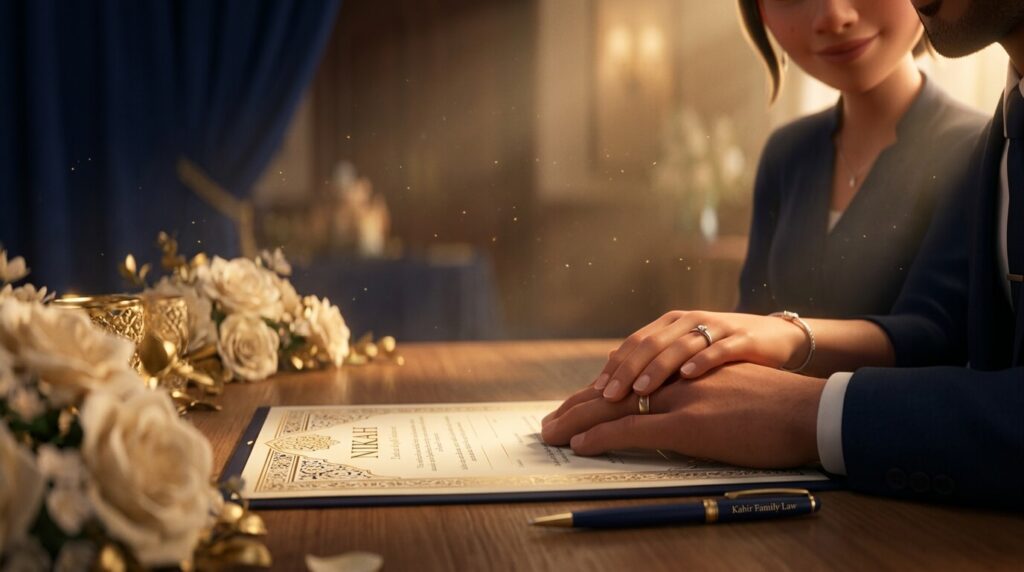
A nikah in Islam is the religious contract of marriage, but on its own it is not usually a legal marriage in England and Wales. You may have made your promises in front of family and witnesses, and called each other husband and wife for years. Even so, the law only sees a marriage that meets the formalities of the Marriage Act 1949. If yours did not, you could have far fewer rights than you expect if you separate or your partner dies. Our divorce specialists assist and advise people facing exactly that question.
If you are planning an Islamic marriage, UK law is not one system, so this guide covers England and Wales only.
Reviewed by: Iblal Iqbal, Partner & Family Law Strategist, Kabir Family Law
Key takeaways
- The ceremony is only part of it. A legal marriage also needs the civil formalities, including a registrar or an authorised person at the ceremony (Marriage Act 1949, s.44).
- A religious wedding can count. It can take place in any religious building registered for marriages, as long as an authorised person or a registrar attends (GOV.UK).
- Some ceremonies create no marriage at all. The Court of Appeal has held that a ceremony outside the rules can be a “non-qualifying ceremony”, which gives no right to a nullity order or financial remedies ([2020] EWCA Civ 122).
- The gaps appear at the hardest moments. Without a legal marriage, there is no automatic right to inherit if your partner dies without a will (GOV.UK).
- Child support still applies. A parent must support a child financially, whether or not they have parental responsibility (GOV.UK).
Is a nikah legal in the UK?
Not by itself, in most cases. The religious ceremony counts in law only when it also meets the civil rules for marriage, which in England and Wales come from the Marriage Act 1949.
The Law Commission has said English law will usually treat religious-only marriages as a “non-marriage”. The Court of Appeal quoted that view in 2020 (Akhter, [2020] EWCA Civ 122, para 11). The result is that the couple have “no legal status” as spouses.
That can feel deeply unfair when your commitment is real. But the legal answer usually matters most at the hardest times: when a couple separate, or when one of them dies. By then, your choices can be much narrower.
What makes a marriage legally valid in England and Wales?
Two things have to be true. First, you must both be free to marry: 18 or over, and not already married or in a civil partnership (GOV.UK). Second, the ceremony has to follow the legal formalities. In outline:
- each of you gives notice at a register office at least 29 days before the ceremony (GOV.UK);
- the ceremony takes place at a register office, approved premises or a religious building registered for marriages (Marriage Act 1949, s.26);
- a registrar or an authorised person is present, with at least two witnesses;
- you sign the marriage schedule, which the register office then adds to the register.
If a ceremony skips one of these steps, it may not be a legal wedding, however meaningful it was to you both. Which step it skipped, and whether the couple knew, can change the legal answer (Marriage Act 1949, s.49). So this is a question to get right, not one to guess.
Can your nikah ceremony also be your legal wedding?
Yes, if it happens in the right place with the right people there. A religious wedding can take place at any religious building registered for marriages. An authorised person, such as a religious minister, must attend and sign the marriage schedule. If the building has no authorised person, you need to book a registrar instead.

Other couples choose two ceremonies. They marry at a register office or an approved venue, and they hold their nikah separately. A register office wedding cannot include a religious service (Marriage Act 1949, s.45(2)). However, you can have a religious blessing after a civil ceremony.
Either way, the paperwork decides the legal answer. The certificate that proves a legal marriage comes from the register, after the register office adds your signed schedule to it. If you planned to register “later” and never did, the religious ceremony alone will not fill that gap.
What if your religious ceremony never reached the register?
The Court of Appeal answered this question in 2020. In the Akhter case, the couple had a nikah at a restaurant in 1998. They knew it had no legal effect and meant to follow it with a civil ceremony, but that never happened. They had four children and separated in 2016 ([2020] EWCA Civ 122).
The first judge treated it as a void marriage, which would have let the wife apply for financial orders. The Court of Appeal disagreed. It held that the ceremony was a “non-qualifying ceremony”. Because it did not create a marriage, “or even a void marriage”, there was no nullity order and no route to financial remedies (paras 65 and 123).
That difference matters a great deal. A void marriage is one the law treats as having no legal effect, for example because the couple disregarded the rules for forming a marriage (Matrimonial Causes Act 1973, s.11). Even so, a nullity order (see our guide to marriage annulment) still lets the court make financial orders, just as it can on divorce (s.23). A non-qualifying ceremony gives no such route.
The court also refused to draw an exact line between the two. Instead, it urged couples to follow the formalities so they can be confident they have made a valid marriage (para 66). So if your ceremony fell short, where you stand depends on its exact facts. That is not something to assume either way.
What does an unregistered Islamic marriage mean for money, home and children?
It can leave a couple married only by nikah far more exposed than spouses. GOV.UK says the rights that come with marriage do not apply to couples who live together without marrying. It adds that common law marriage does not exist, however long you have lived together. Our guide to common law marriage explains why.
| What is at stake | Religious ceremony only | Legal marriage |
|---|---|---|
| Your status | Usually no legal status as spouses | Legally each other’s spouse |
| If you separate | No divorce or nullity route to financial orders | The court can make financial orders on divorce |
| If one of you dies without a will | No automatic right to inherit | A right to inherit |
| A father’s parental responsibility | Only through the birth register, an agreement or a court order | Usually automatic if married to the mother at the birth |
What happens to your home if you separate?
GOV.UK says the rules are different for couples who never married (GOV.UK). A dispute over a shared home usually turns on property and trust law instead (Trusts of Land and Appointment of Trustees Act 1996, s.14). As a result, whose name is on the deeds, and who paid for what, can matter far more. A cohabitation agreement can record what you both intend, but it does not make you spouses.
What about your children?
A parent must support a child financially either way. But a father who had not married the mother before the birth gets parental responsibility only through the birth register, a parental responsibility agreement or a court order (Children Act 1989, s.4).
What if your partner dies without a will?
There is no automatic right to inherit. A partner who lived with them as a couple for the two years before the death can ask a court for reasonable financial provision. However, that is a court claim, not an automatic right (Inheritance (Provision for Family and Dependants) Act 1975, s.1).
Each of these gaps is far easier to deal with while you are both well and still together. After a separation or a death, it can be too late to change the position.
If this sounds like your situation, a free initial consultation is a calm first step. One of our specialists gives you initial advice on where you stand.
Does the law recognise your nikah? Tick what is true
This check shows what you know and what is still unclear. It cannot tell you your legal status.
There is no score. Anything you cannot tick yet is worth raising before your circumstances change.
The calls a checklist can’t make for you
- Whether your ceremony counts in law as a marriage, a void marriage or no marriage at all, and what follows from each.
- What claims, if any, you could make over the home or savings.
- How to protect your children and yourself if you separate or one of you dies.
These depend on the facts of your case.
Book a free initial consultation
One of our specialists will give you initial advice on your situation.
Frequently asked questions
Is a nikah the same as marriage?
In faith, it is a marriage. In the law of England and Wales, it counts only if the ceremony also met the civil formalities, such as a registered building and an authorised person or registrar. Otherwise, the law may not treat you as married at all, even after many years together.
What is a nikah, and what happens at one?
It is the contract of marriage in Islam. Practices differ between families, so the imam or mosque leading your ceremony is the right person to ask about the religious side. The legal side is the same for every faith. Ask whether the building is registered for marriages, and whether an authorised person or a registrar will attend.
Is a nikah certificate proof of marriage?
It shows that your religious ceremony took place. On its own, though, it does not prove a legal marriage. The legal record comes from the register, once the register office adds the signed marriage schedule to it (GOV.UK).
Can we register our marriage after the religious ceremony?
Not in a way that makes the earlier ceremony count. The Court of Appeal said courts judge a ceremony’s legal effect as at the day it takes place (Akhter, para 124). What you can do is give notice and marry at a civil ceremony. The law then treats you as married from that day.
Do we need a divorce if we never registered our marriage?
If the law never saw a marriage, there is nothing for a divorce to end. If you did marry legally, even at a separate civil ceremony, a no-fault divorce is the legal way to end it.
Married by nikah only? Check where you stand before anything changes
Whether the law sees you as married shapes what happens to your home, your savings and your children if life changes suddenly. Book a free initial consultation and one of our specialists will give you initial advice on your position. You can also read more about our divorce specialists.
Expert Tip
Couples who had a religious ceremony years ago often ask us whether the law sees them as married. Some only find out when the relationship ends, or when a partner dies, that it may not. By then, the choices can be far more limited. If your ceremony never made it onto the register, get advice while things are calm, before a crisis forces the question.
Garry Steedman, Family Law Consultant (Divorce, Children & TOLATA)